
What Happens When You Have Both Anxiety and Depression?
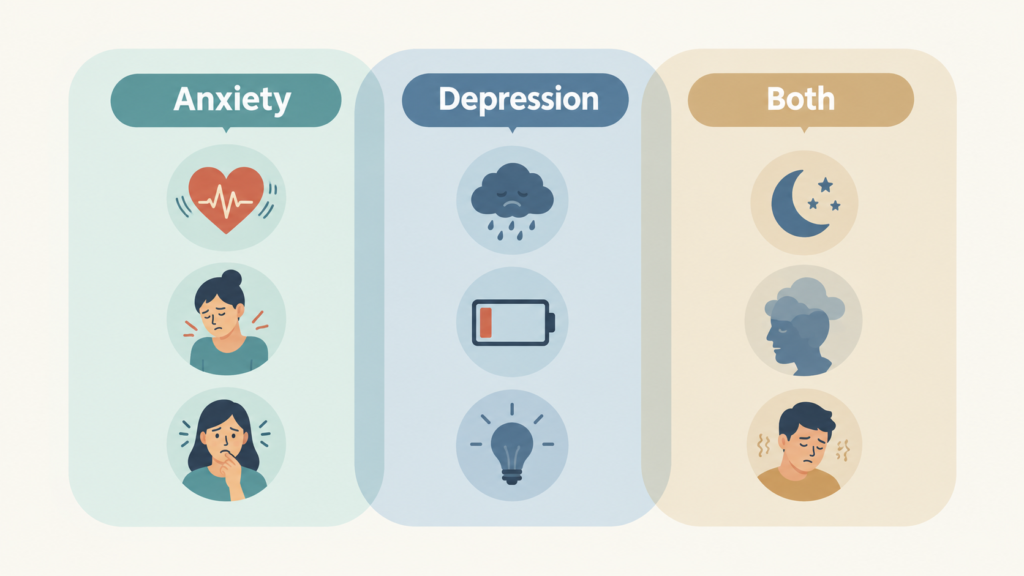
Medically reviewed by Dr. Ijeoma Mbionwu, DNP, PMHNP-BC | Review date: October 22, 2026 Anxiety and depression together are more common than most people expect. When both show up, worry and low mood feed each other. Sleep slips. Focus fades. Even a simple day can feel heavy. Here’s the hopeful part: both are treatable, often with the same plan. This guide covers the shared signs, why the two travel as a pair and what helps. You can find care in Orlando or by telehealth anywhere in Florida. Key Takeaways Table of Contents How Common Is It to Have Both? Very common. The Anxiety and Depression Association of America reports that close to half of people diagnosed with depression also have an anxiety disorder. Numbers shift from study to study, so treat that as a rough picture rather than an exact count. Look, that means you’re far from alone. Plenty of people carry both and still hold down jobs, raise kids and show up for friends. They just do it with extra weight on their shoulders. Signs of Anxiety vs Signs of Depression The two conditions feel different at the core. Anxiety pushes you toward fear and tension. Depression pulls you toward heaviness and emptiness. But they overlap in the middle, which is why people often can’t tell which one they’re dealing with. Anxiety Depression Both can cause Constant worry or fear Persistent sadness or emptiness Poor sleep Restlessness, feeling on edge Loss of interest in things you enjoyed Trouble focusing Racing heart, tense muscles Low energy, slowed down Irritability Avoiding situations Hopeless or worthless thoughts Tiredness What are 5 symptoms of anxiety? The National Institute of Mental Health lists symptoms like these. Five to watch for: Anxiety can also lead you to avoid people, places or tasks that set off your worry. What Happens When You Have Anxiety and Depression Together? Picture a loop. Worry keeps you awake. Poor sleep leaves you drained. Exhaustion drags your mood down. A low mood tells you nothing will get better, and that thought sparks fresh worry. Round and round it goes. Here’s what that can look like on an ordinary Tuesday. You lie awake replaying a mistake at work. By morning you’re wiped out. You skip lunch with a friend because you can’t face it. Then you worry about what the friend thinks. The avoiding feels like relief for an hour. It adds fuel by evening. When both conditions are present, everyday tasks can take more effort. Concentrating gets harder. Decisions feel heavier. Irritability can creep into relationships. None of this means you’re weak. It means two systems are pulling on each other at once. Why Do They Occur Together? Researchers don’t point to a single cause. Instead, anxiety and depression share several risk factors: One can also lead to the other. Months of constant worry can wear you down until your mood sinks. And depression often brings racing, repetitive thoughts that feel a lot like anxiety. Think about it: it’s not surprising that a mind under steady strain eventually runs low on both energy and hope. How Can You Overcome Anxiety and Depression? Many people feel meaningfully better with treatment. Recovery isn’t a straight line, and you may have off days along the way. But it’s a realistic goal, and you don’t have to figure it out alone. Treating both conditions is a core part of psychiatric care, and a provider can build one plan that covers them together. Therapy. Cognitive-behavioral therapy helps untangle the link between thoughts, mood and behavior. It teaches you to catch worry spirals early and to act even when motivation is low. For a deeper look at anxiety specifically, see anxiety treatment Orlando and our guide to the best treatments for anxiety. Medication. Some medicines help with both conditions, which is one reason a single plan can cover the pair. Your provider chooses based on your symptoms, history and goals. A note on controlled medicines: certain sleep medicines and some short-term anxiety medicines carry extra federal and Florida telehealth rules that change over time, so your provider will explain what applies. Learn more on our depression treatment Orlando page. Daily habits. Habits won’t replace treatment, but they help it work. Keep a steady sleep schedule. Move your body in ways you can actually stick with. Cut back on alcohol, which can worsen both. Stay in touch with at least one person you trust. Not sure which condition you’re dealing with? Read how to know if you have anxiety or depression for a simple way to sort it out. Prefer to stay home? Telehealth lets people anywhere in Florida see a psychiatric provider by video. See treating anxiety and depression online for how it works. Here is the thing: you don’t have to wait until you feel “bad enough.” Starting earlier often makes the road shorter. Other Conditions That Can Look Similar Several other conditions share symptoms with anxiety and depression, which is why a proper evaluation matters: A provider can sort out what’s really going on. Treating the wrong thing wastes time, and nobody has time to spare when they’re struggling. Getting Help in Orlando or by Telehealth StarMaris offers in-person psychiatric care at 5000 W Colonial Dr, Orlando, and telehealth for people anywhere in Florida. A first visit starts with a conversation about what you’re feeling, how long it has lasted and how it affects your days. From there, you and your provider build a plan together. If you’re in crisis or have thoughts of harming yourself, don’t wait for an appointment. Call or text 988 or call 911. Frequently Asked Questions What happens when you have both anxiety and depression? Worry and low mood tend to feed each other. Anxiety can disrupt sleep and drain energy, which worsens mood, and depression can bring hopeless, repetitive thoughts that fuel anxiety. Focus, motivation and relationships may suffer. Both conditions are treatable, often with the same plan. How can I overcome anxiety and depression? Most people improve
What Kind of Doctor Does Medication Management for Mental Health?

Medically reviewed by Dr. Ijeoma Mbionwu, DNP, PMHNP-BC | Review date: October 22, 2026 What kind of doctor does medication management? Several kinds of providers can. Psychiatrists, psychiatric nurse practitioners (PMHNPs), primary care providers and some physician assistants all manage psychiatric medication. A psychiatric specialist is often the best fit when symptoms are complex or the first medicines haven’t worked. Primary care still does solid work for milder, steady cases. This guide sorts out who does what and what the visits involve. You can get medication support in person in Orlando or by telehealth across Florida. Key Takeaways Table of Contents What Is Medication Management for Mental Health? Medication management is the ongoing work of choosing, starting, monitoring and adjusting a psychiatric medicine over time. It isn’t a single prescription handed across a desk. Picture a loop instead. Your provider checks whether the medicine helps, whether side effects bother you and whether the dose still fits your life. Our mental health medication management service page walks through how that loop works in practice. The National Institute of Mental Health explains that mental health medicines can ease symptoms of many conditions and that how people respond varies from one person to the next. Look, nobody lands on the perfect medicine on day one. Adjusting is part of the process. It doesn’t mean something went wrong. What Kind of Doctor Does Medication Management? Several types of providers can prescribe and manage mental health medication. Here’s how they compare. Provider Can I prescribe? Best for Psychiatrist (MD/DO) Yes Complex or severe conditions Psychiatric nurse practitioner (PMHNP) Yes Evaluation, diagnosis and ongoing medication care Primary care provider Yes Mild, stable conditions Psychologist or therapist Generally no Talk therapy alongside medication A few details help make sense of that table. Psychiatrists are physicians who completed medical school and then trained in psychiatry. They often see people with layered or hard-to-treat conditions. PMHNPs are nurse practitioners with advanced training in psychiatric and mental health care. A board-certified PMHNP can evaluate, diagnose and prescribe, so the day-to-day medication care looks much the same as it does with a psychiatrist. The “BC” at the end of a credential like PMHNP-BC signals national board certification. Primary care providers deserve real credit here. Many start treatment for depression and anxiety and plenty of people do well with that care. It’s often the easiest first step because you already know the office. Psychologists and therapists generally don’t prescribe. They pair with a prescriber and the combination often works better than either one alone. For the bigger picture, see our overview of psychiatric care. When to See a Psychiatric Specialist Instead of Primary Care Primary care can be a great starting point. But a psychiatric specialist may suit you better in some situations: ADHD is a common example. Evaluation and treatment often call for a psychiatric provider who handles it regularly. Our guide on what a psychiatrist will do for ADHD shows what that looks like. Here is the thing: seeing a specialist doesn’t mean your primary care doctor failed you. It means your situation calls for a closer look. Many people keep both on their team. What Happens at a Medication Management Visit? Your first visit is mostly an evaluation. Your provider asks about your symptoms, health history, current medicines, allergies and family background. If pregnancy is possible or planned, say so. It changes which medicines make sense. Next, you talk through options. A good provider explains what a medicine is meant to do, what side effects to watch for and what to expect over the first weeks. You can ask anything. Seriously, anything. Follow-up visits are shorter. Your provider checks how you’ve been feeling, asks about sleep and appetite, reviews side effects and decides whether to keep, adjust or change the plan. Many people find these visits more like a check-in than an exam. Price comes up often before booking. Our guide on how much medication management costs covers typical ranges, which vary by provider and insurance. How Often Are Medication Management Appointments? At the start, expect visits fairly close together. A typical range is every two to four weeks while you’re beginning or adjusting a medicine. Once your symptoms settle, visits often space out to every one to three months. Some people stable for a long time go even less often. All of this varies by person and provider. Why the early rush? New medicines need watching. Your provider wants to catch side effects early and see how you’re responding. Many people ask when they’ll feel a difference. Our guide on how long antidepressants take to work explains typical timelines and why patience matters. Can I Get Medication Management Online? Often, yes. Telehealth lets people anywhere in Florida see a psychiatric provider by video for medication management when it’s appropriate. You do need to be in Florida during the visit. Your provider decides whether a video visit is enough for your situation. One caution. Some medicines, such as certain sleep medicines and ADHD stimulants, are controlled substances with extra federal and Florida telehealth rules. Those rules change, so ask your provider what applies before you assume anything. Medication Works Best as Part of a Plan Think about it this way: a pill can ease symptoms, but it can’t rebuild a routine. Most plans do better with support around the medicine: Two safety points matter here. Don’t stop a psychiatric medicine suddenly on your own, because that can cause unpleasant effects or bring symptoms back. And tell your provider about everything else you take, including supplements and over-the-counter products. How StarMaris Handles Medication Management At StarMaris, medication care is led by Dr. Ijeoma Mbionwu, DNP, PMHNP-BC, a psychiatric-mental health nurse practitioner who can evaluate, diagnose and prescribe. Visits start with an evaluation and move into follow-ups that adjust as you do. You’re part of every decision. Frequently Asked Questions What kind of doctor does medication management? Psychiatrists, psychiatric nurse practitioners (PMHNPs), primary care providers and some physician assistants can
Telepsychiatry vs Telehealth: What’s the Difference?

Medically reviewed by Dr. Ijeoma Mbionwu, DNP, PMHNP-BC | Review date: October 22, 2026 Telehealth is any healthcare delivered remotely. Telepsychiatry is the mental health branch of it. It brings psychiatric evaluation, diagnosis, medication management and therapy to you by secure video. That’s the core of telepsychiatry vs telehealth in two sentences. A general telehealth app might connect you with a doctor about a rash. Telepsychiatry connects you with a psychiatric provider who can diagnose and prescribe. StarMaris offers it anywhere in Florida. Below, you’ll see what it treats, how a visit works and when in-person care fits better. Key Takeaways Table of Contents Quick Answer: Telehealth vs Telepsychiatry Telehealth covers every kind of remote care, from primary care to urgent care to therapy. Telepsychiatry covers only psychiatric care. The biggest practical difference is who’s on the other end of the screen. With telepsychiatry, it’s a psychiatric provider trained to diagnose mental health conditions and manage psychiatric medication. Telehealth Telepsychiatry What it covers Any remote healthcare (primary care, urgent care, therapy and more) Psychiatric care only Typical services Video, phone and patient-portal visits Psychiatric evaluation, diagnosis, medication management, therapy Provider Any licensed clinician Psychiatric provider (psychiatrist or psychiatric nurse practitioner) Can prescribe? Depends on the provider Yes, psychiatric medication when appropriate What Is the Meaning of Telepsychiatry? Telepsychiatry means getting psychiatric care through a live video visit instead of an office visit. You talk with a licensed psychiatric provider in real time. They ask questions, listen and build a plan with you, just as they would across a desk. The care is the same kind of care. Only the location changes. The National Institute of Mental Health notes that technology is widening access to mental health treatment, and video visits are a big part of that shift. Look, the word sounds technical. It isn’t. If you can join a video call with a relative, you can do this. Telepsychiatry is one part of broader psychiatric care, delivered by video instead of in an office. What Can Telepsychiatry Treat? Many everyday mental health concerns work well over video. Common ones include: Telepsychiatry also suits people who just need a medication check. A ten-minute adjustment shouldn’t cost an afternoon. Can Telepsychiatry Prescribe Medication? Yes, after a proper evaluation. Your provider reviews your symptoms, history and current medicines first. If medication fits, they send a prescription electronically to the pharmacy you choose. Here is the thing about controlled medicines. Some, such as certain sleep medicines and ADHD stimulants, have extra federal and Florida rules for telehealth. Those rules change over time. Your provider will tell you what applies in your case, so don’t assume every medicine works the same way over video. How a Telepsychiatry Visit Works, Step by Step Most visits follow the same flow: Our telepsychiatry service page covers the booking details. Cost is the other question people ask before booking. Our guide on how much an online psychiatrist costs gives typical ranges, which vary by provider and insurance. Rules for Telehealth in Florida Telehealth has a few ground rules. The main one for Florida: you need to be in the state during your visit. A provider licensed here can’t see you from another state under the same arrangement. Traveling out of state? Check with the practice before booking, because the visit may need to wait. A few practical points: Think about it: a private room matters more than fancy equipment. A car parked somewhere quiet works if home is crowded. When In-Person Care Is the Better Choice Video works for plenty of people. It doesn’t work for everyone. Some situations call for an in-person visit: If you typed “psychiatric provider near me” into a search bar, you may be leaning that way. Plenty of people in Orlando prefer a physical office, and that’s a perfectly good reason to choose one. Wondering if video is enough for a diagnosis? Read can a telehealth psychiatrist diagnose you for a closer look. One safety note. Telepsychiatry isn’t built for emergencies. If you’re in crisis, call or text 988 or call 911. How StarMaris Offers Telepsychiatry Across Florida StarMaris offers telepsychiatry for people anywhere in Florida. Visits are led by Dr. Ijeoma Mbionwu, DNP, PMHNP-BC, a psychiatric-mental health nurse practitioner who can evaluate, diagnose and prescribe. You can also see the practice in person when that suits you better. Pick whichever format feels right, and switch if your needs change. Frequently Asked Questions What is the meaning of telepsychiatry? Telepsychiatry is psychiatric care delivered by live video instead of an office visit. A licensed psychiatric provider evaluates your symptoms, makes a diagnosis, manages medication when needed and follows your progress over time. It covers the same kind of care you’d get in person, just from your own space. What is the difference between telehealth and telepsychiatry? Telehealth is the broad term for any remote healthcare, including primary care and urgent care. Telepsychiatry is one type of telehealth focused only on psychiatric care. It’s delivered by a psychiatric provider who can diagnose mental health conditions and prescribe psychiatric medication when appropriate. Can telepsychiatry prescribe medication? Yes, after a proper evaluation. Your provider sends prescriptions electronically to your pharmacy. Some controlled medicines, such as certain sleep medicines and ADHD stimulants, have extra federal and Florida telehealth rules that can change. Your provider will explain what applies to you. Is telepsychiatry private and secure? It should be. Reputable practices use secure, encrypted video platforms that meet HIPAA privacy requirements. Ask your provider which platform they use. You can protect your own privacy by joining from a private room, using headphones if others are nearby and avoiding public Wi-Fi. Do I need to live in Orlando to use telepsychiatry? No. You can use telepsychiatry from anywhere in Florida. The key rule is that you must be located in Florida during your appointment. Living in Orlando isn’t required, and you don’t need to travel to an office. Book Telepsychiatry Anywhere in Florida StarMaris offers telehealth for people across
How to Prepare for a Mental Health Assessment (and What Happens During One)

Medically reviewed by Dr. Ijeoma Mbionwu, DNP, PMHNP-BC | Review date: October 22, 2026 Here’s how to prepare for a mental health assessment: write down your symptoms and how long they’ve lasted, list your medicines and supplements, gather past records, note your family history and bring your questions. That’s most of it. The rest is showing up honestly. You can have your visit in person in Orlando or by telehealth across Florida, and the prep looks the same either way. Below, you’ll see what happens in the room, what to say and what to skip. Key Takeaways Table of Contents What Is a Mental Health Assessment? A mental health assessment is a guided conversation. Your provider asks about what you’re feeling, how long it’s been going on and how it affects your days. The goal is simple: work out what’s behind your symptoms and what could help. You may also hear it called a psych evaluation or psychiatric evaluation. The names change, but the idea doesn’t. According to the what-is-psychiatry, psychiatric providers use this kind of review to reach a diagnosis and plan treatment. Nobody grades you. Nobody expects polished answers. Rambling is fine. Think of it as a first conversation about psychiatric care rather than an exam you can fail. What Happens in a Psychiatric Evaluation? Most evaluations follow a loose script. Your provider will move through these areas, usually in this order: Along the way, you may fill out a short questionnaire. The PHQ-9 covers depression with nine questions. The GAD-7 covers anxiety with seven. Both take a few minutes, and they give your provider a baseline to track over time. Some visits include a diagnostic mental health assessment, which digs into whether your symptoms match a specific condition. Then comes the part people forget to expect: a plan. You leave with next steps, not just questions. How to Prepare for a Mental Health Assessment: Your Checklist Good prep saves time. It also keeps you from blanking mid-visit, which happens to almost everyone. Use this checklist and jot notes on your phone if paper feels like too much. Bring or prepare Why it helps List of symptoms and when they started Shows the pattern and how long it has lasted All medicines, supplements and doses Avoids interactions and shows what has been tried Past mental health records or diagnoses Saves time and avoids repeating tests Family mental health history Some conditions run in families Notes on sleep, alcohol or substance use Affects diagnosis and treatment choices Your questions and goals Makes sure the plan fits what you want A few extra tips: What Not to Say (and What to Say Instead) Look, there are no wrong answers in a psychiatric evaluation. Providers have heard it all. What trips people up isn’t saying the wrong thing. It’s leaving things out. Here are the habits worth dropping: Here is the thing: the more accurate your answers, the better the plan. Honesty isn’t a test of character. It’s just useful data. Can You Get a Full Psychiatric Evaluation? Yes. A comprehensive psychiatric evaluation is a longer, deeper review of your symptoms, history and daily life. It’s different from a short screening, which only flags whether something might be going on. A screening works like a smoke alarm. It tells you to look closer. A full evaluation is the look itself. Some situations call for extra testing on top of the evaluation. ADHD is a common one, since it often involves rating scales and a review of childhood history. Memory concerns may involve short cognitive screening tasks. Your provider will explain what’s needed and why before adding anything. In-Person or Telehealth Assessment in Florida Both formats can work well. An in-person visit in Orlando suits people who like face-to-face conversation or want a visit away from home. Telehealth suits people who’d rather talk from their own couch. For telehealth, you need to be in Florida during the visit. That’s the main rule. Beyond that, set yourself up for a smooth call: Think about it: most people say the hardest part is the first five minutes. A familiar space often makes those minutes easier. What Happens After Your Assessment Once your provider has the full picture, you’ll talk through what they found. If your symptoms fit a diagnosis, they’ll explain it in plain language. If they don’t, you’ll still get guidance on what to do next. Then you’ll go over treatment options, which could include medication, therapy or both, and agree on a follow-up date. Cost is a common worry before booking. Our guide on how much a psychiatrist costs in Florida covers typical ranges, which vary by provider and insurance. If attention and focus are your main concern, read about how to get diagnosed with ADHD as an adult. A note on medicines: some, such as ADHD stimulants and certain sleep medicines, are controlled substances with extra federal and Florida telehealth rules. Those rules change, so your provider will explain what applies. Wondering about timing? We explain how long a psychiatric evaluation takes in a separate guide. For more on finding support, the National Institute of Mental Health offers a helpful starting point. How StarMaris Approaches Assessments At StarMaris, assessments are led by Dr. Ijeoma Mbionwu, DNP, PMHNP-BC. As a psychiatric-mental health nurse practitioner, Dr. Mbionwu can evaluate and diagnose conditions and prescribe medication when it’s needed. The visit is built around conversation rather than a checklist. You can ask questions at any point. You can also slow down whenever a topic feels heavy. By the end, you’ll know what was found and what comes next. That might mean starting treatment or adding more testing. Frequently Asked Questions What happens in a psychiatric evaluation? Your provider asks about your current symptoms, personal and family history, medicines, sleep, mood, appetite and substance use. They’ll also check on your safety. You may complete short questionnaires. The visit ends with a discussion of what they found, possible diagnoses and a treatment plan with a
What Is Psychiatric Care? How to Tell If You Need It

Medically reviewed by Dr. Ijeoma Mbionwu, DNP, PMHNP-BC | Review date: October 22, 2026 Psychiatric care is medical care for mental health. It includes an evaluation, a diagnosis, medication when it helps, therapy and regular follow-up. Picture a checkup for your mood and energy, with a real plan attached. This guide is for anyone wondering whether what they feel is “bad enough” to see a professional. Family members trying to understand that first visit will find it useful too. You can get psychiatric care in person in Orlando or by video anywhere in Florida. So how do you know it’s time to reach out? Key Takeaways Table of Contents What Is Psychiatric Care? (Quick Answer) Psychiatric care is medical care that diagnoses and treats mental health conditions. A psychiatric provider reviews your history and symptoms, then names a diagnosis if one fits. After that, the two of you build a plan. It might include medication, therapy or both, plus regular check-ins to see what’s working. The goal isn’t to label you. It’s to help you feel steadier and get back to the things that matter. Why Do People Need Psychiatric Care? Mental health conditions are more common than most people assume. According to the National Institute of Mental Health, roughly one in five U.S. adults lives with a mental illness in a given year. Exact numbers shift from survey to survey. Look, that means someone in your office, your family or your child’s school is likely dealing with something right now. Many never say a word. Some wait years before they ask for help, because they figure their struggles aren’t serious enough. People come to psychiatric care for plenty of reasons. Grief may refuse to lift. A health problem, a new baby or a hard move can knock your mood sideways. Sometimes nothing obvious changed at all. You just feel off. Genetics, brain chemistry, stress and life events all play a part, and a trained provider can sort out which ones matter in your case. Here is the thing: you don’t need to hit a breaking point to deserve support. Getting help earlier often shortens the road back. Signs You May Need Psychiatric Care Not every rough patch calls for a psychiatric provider. But some patterns point that way. Watch for these: Physical clues count too. Headaches, stomach trouble and constant tiredness sometimes trace back to stress or mood. One sign on its own doesn’t mean you have a disorder. What matters is the pattern. If several show up together, last more than a couple of weeks or start to hurt your work or relationships, it’s time to talk to someone. Think about it this way: if a sore knee kept you from walking for two weeks, you’d see a doctor. Your mind deserves the same attention. Psychiatry vs Psychology vs Therapy: What’s the Difference? These roles overlap, and the names confuse almost everyone. The American Psychiatric Association describes psychiatry as a medical specialty focused on diagnosing and treating mental illness. Psychology and therapy lean on testing and talk-based work instead. Here’s a quick side-by-side. Provider What they do Can prescribe medication? Psychiatric provider (psychiatrist or psychiatric nurse practitioner) Evaluates, diagnoses and treats mental health conditions; manages medication Yes Psychologist Testing, assessment and talk therapy Generally no (in most states) Therapist or counselor (LMHC, LCSW, LMFT) Talk therapy and coping skills No Many people see more than one. A psychiatric provider might manage your medication while a therapist helps you build coping skills each week. The two roles support each other. Can I just go straight to a psychiatrist? Often, yes. Many psychiatric practices accept new patients without a referral from a primary care doctor. Some insurance plans, particularly HMOs, do ask for one. A quick call to your insurer before booking settles the question. What Does Psychiatric Care Treat? Psychiatric providers work with a long list of conditions. Here are some of the most common: What Happens When You Start Psychiatric Care? A first visit feels far less intimidating once you know the steps. Most psychiatric care follows the same four-part path. Two of those steps deserve a closer look on their own pages. See psychiatric evaluations for how the first visit works, and diagnostic assessments for how a diagnosis gets reached. Your Treatment Options: Medication, Therapy or Both There’s no single right answer here. Your symptoms, history and preferences guide the choice. Medication. Medication management means choosing a medicine, tracking how it works and adjusting it over time. Many people use it for depression, anxiety, ADHD and bipolar disorder. A small group of medicines, such as some sleep medicines and ADHD stimulants, are controlled substances. They come with extra federal and Florida rules, including for telehealth, and those rules change. Your provider will explain what applies to you. Therapy. Therapy gives you tools and a steady place to talk. Short, goal-focused styles such as solution-focused therapy suit people who want practical steps quickly. Comparing approaches? Our guide to types of therapy for mental health breaks down the main options. Both together. Some people do best with a mix. Medication can steady symptoms enough that therapy skills actually stick. Others start with therapy alone and add medication later, or never need it. Either path is normal. In-Person or Telehealth: Getting Care in Florida Psychiatric care comes in two formats. Both work well for many people. Many people in the Orlando area choose in-person psychiatric care because face-to-face conversation feels more natural. It can also make hard topics easier to raise. Telehealth lets people anywhere in Florida see a psychiatric provider by video. You skip the commute and the waiting room. All you need is a private space, a steady internet connection and a phone or computer. You do need to be in Florida during the visit. You can book online appointments across Florida for follow-ups, busy weeks or anything else that makes travel hard. Not sure which one fits? Our breakdown of telepsychiatry vs telehealth explains the difference